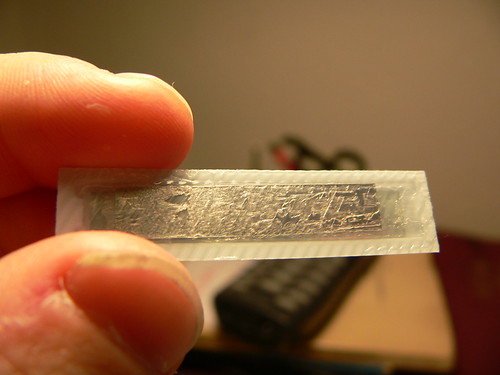
Showing posts with label Health Record. Show all posts

Tuesday, November 24, 2009


step 2Where can RFID chips be found


As RFID chips become cheaper, the number of devices that include them grows.

Currently there are RFID tags in:

- US passports: The RFID tag contains all the information that is written in the passport, along with a digital picture

- Transportation payments: Things like New York's EZ Pass, Florida's Sun Pass, and California's Fast Trak are all RFID based toll payment systems.

- Access control: Many buildings and schools require RFID tagged cards to be used for entry.

- Credit cards: Chase, and a few other banks, now issue credit cards embedded with RFID chips, called "blink". They are able to convince people it is an added convenience, but in reality it is a huge security risk.


There are many other devices which contain RFID tags; however, the ones listed are the most common and offer the greatest security risk.

introHow to block/kill RFID chips


introHow to block/kill RFID chips


In this Instructable I will describe different ways to block or kill RFID tags. RFID stands for Radio Frequency Identification. If you do not know about this technology yet, you should definitely start familiarizing yourself with it, because the number of different devices that utilize these types of tags is growing exponentially.

RFID chips are very similar to barcodes in the sense that a certain amount of data is contained within them, and then transmitted to a reading device which then processes and utilizes the information. The major difference is that barcodes have to be physically visible to the reading device, which is usually only able to scan them at a distance of a 12 inches or less. RFID tags, on the other hand, do not have to be visible to the reading device. They can be scanned through clothes, wallets, and even cars. The distance from which they can be read is also much greater than that of a barcode. At DEFCON an RFID tag was scanned at a distance of 69 feet, and that was back in 2005, the possible reading distance now is probably much greater than that.

There are a few different categories of RFID tags, but the most common ones, and the ones we will be dealing with in this instructable, are the "passive" type. Passive RFID chips contain no internal power supply. They contain an antenna which is able to have a current induced in it when within range of the RFID reader. The tag then uses that electricity to power the internal chip, which bounces its data back out through the antenna, where it will be picked up by the reader.

For more information on RFID tags check out the wikipedia entry.


Who's using RFID?

Thing by Jakob Smith.RFID is already in use all around us. Ever chipped your pet dog or cat with an ID tag? Or used an EZPass through a toll booth? Or paid for gas using ExxonMobils' SpeedPass? Then you've used RFID.

Some uses, especially those related to security, seem like a great idea. For instance, Delta is testing RFID on some flights, tagging 40,000 customer bags in order to reduce baggage loss and make it easier to route bags if customers change their flight plans.

Three seaport operators - who account for 70% of the world's port operations - agreed to deploy RFID tags to track the 17,000 containers that arrive each day at US ports. Currently, less than 2% are inspected. RFID tags will be used to track the containers and the employees handling them.

The United States Department of Defense is moving into RFID in order to trace military supply shipments. During the first Gulf War, the DOD made mistakes in its supply allocation. To streamline operations, the U.S. military has placed RFID tags on 270,000 cargo containers and tracks those shipments throughout 40 countries.

On a smaller level, but one that will instantly resonate with security pros, Star City Casino in Sydney, Australia placed RFID tags in 80,000 employee uniforms in order to put a stop to theft. The same idea would work well in corporate PCs, networking equipment, and handhelds.

In all of these cases, RFID use seems reasonable. It is non-intrusive, and it seems to balance security and privacy. Other uses for RFID, however, may be troublesome.

Visa is combining smart cards and RFID chips so people can conduct transactions without having to use cash or coins. These smart cards can also be incorporated into cell phones and other devices. Thus, you could pay for parking, buy a newspaper, or grab a soda from a vending machine without opening your wallet. This is wonderfully convenient, but the specter of targeted personal ads popping up as I walk through the mall, a la Minority Report, does not thrill me.

Michelin, which manufactures 800,000 tires a day, is going to insert RFID tags into its tires. The tag will store a unique number for each tire, a number that will be associated with the car's VIN (Vehicle Identification Number). Good for Michelin, and car manufacturers, and fighting crime. Potentially bad for you. Who will assure your privacy? Do you really want your car's tires broadcasting your every move?

The European Central Bank may embed RFID chips in the euro note. Ostensibly to combat counterfeiters and money-launderers, it would also enable banks to count large amounts of cash in seconds. Unfortunately, such a move would also makes it possible for governments to track the passage of cash from individual to individual. Cash is the last truly anonymous way to buy and sell. With RFID tags, that anonymity would be gone. In addition, banks would not be the only ones who could in an instant divine how much cash you were carrying; criminals can also obtain power transceivers.

Several major manufacturers and retailers expect RFID tags to aid in managing the supply chain, from manufacturing to shipping to stocking store shelves, including Gillette (which purchased 500 million RFID tags for its razors), Home Depot, The Gap, Proctor & Gamble, Prada, Target, Tesco (a United Kingdom chain), and Wal-Mart. Especially Wal-Mart.

The retail giant, the largest employer in America, is working with Gillette to create "smart shelves" that can alert managers and stockboys to replenish the supply of razors. More significantly, Wal-Mart intends for its top 100 suppliers to fully support RFID for inventory tracking by 2005. Wal-Mart would love to be able to point an RFID reader at any of the 1 billion sealed boxes of widgets it receives every year and instantly know exactly how many widgets it has. No unpacking, no unnecessary handling, no barcode scanners required.

RFID Chips Are Here


RFID chips are being embedded in everything from jeans to paper money, and your privacy is at stake.

Bar codes are something most of us never think about. We go to the grocery store to buy dog food, the checkout person runs our selection over the scanner, there's an audible beep or boop, and then we're told how much money we owe. Bar codes in that sense are an invisible technology that we see all the time, but without thinking about what's in front of our eyes.

Bar codes have been with us so long, and they're so ubiquitous, that its hard to remember that they're a relatively new technology that took a while to catch on. The patent for bar codes was issued in 1952. It took twenty years before a standard for bar codes was approved, but they still didn't catch on. Ten years later, only 15,000 suppliers were using bar codes. That changed in 1984. By 1987 - only three years later! - 75,000 suppliers were using bar codes. That's one heck of a growth curve.

So what changed in 1984? Who, or what, caused the change?

Wal-Mart.

When Wal-Mart talks, suppliers listen. So when Wal-Mart said that it wanted to use bar codes as a better way to manage inventory, bar codes became de rigeur. If you didn't use bar codes, you lost Wal-Mart's business. That's a death knell for most of their suppliers.

The same thing is happening today. I'm here to tell you that the bar code's days are numbered. There's a new technology in town, one that at first blush might seem insignificant to security professionals, but it's a technology that is going to be a big part of our future. And how do I know this? Pin it on Wal-Mart again; they're the big push behind this new technology.

So what is it? RFID tags.

Tuesday, November 17, 2009

VeriChips Violate Privacy


VeriChips Violate Privacy

Radio frequency identification chips are ubiquitous little buggers. Most of us already use them
without realizing. If you've ever flown through a toll booth using an
EZPass, quickly purchased gas with ExxonMobils' SpeedPass, or chipped
your French poodle Francesca with an ID tag, you're onboard the RFID
bandwagon.
RFID tags are microchips, generally a wee-bit longer than a rice
grain, that act as transmitters, always ready for a radio wave signal
to pick them up. The tag responds by sending a unique ID code back to
the transceiver, or RFID reader, whichever asked the chip to respond.
Many other uses have already been found for the RFID chips, including
replacing keys for access to top-security labs, Prius car owners to
start their engines, and giant corporations like Wal-Mart employ the
high-tech tool to track inventory.
Soon products we purchase will contain them too. US passports will
come chip equipped and Michelin plans on inserting tags into their
tires. Anonymity and privacy are about to become part of the past.
But now there's a new personal use for the chip on the market-an
eerily invasive method that gets you right under the skin. VeriChip Corporation is the only purveyor of the
VeriChip human ID implant, injected into one's right arm.
Implantable tags for humans are a complete violation of privacy-an
unprecedented way for Big Brother to spy on anyone, anywhere, anytime.
The VeriChip can provide any information you store on it, identity
information, medical history, credit card, bank account info,
or access to your building's office. In the future you won't even have
to bust out your wallet for a Coke at the vending machine. The most
personal information and most menial transactions will be done from
your arm. Nothing could be more convenient.
But having government being able to track my every move anywhere on
the planet doesn't appeal me. Furthermore, I won't have my arm scanned
for others to more easily retrieve my most private records. I
refuse to reduce myself to nothing more than a barcode.
What proves truly troublesome comes in the information VeriChip was
reluctant to disclose about their product. "A hacker can simply walk
by a chipped person and clone his or her VeriChip signal, a threat


already demonstrated by security researches," according to Liz
McIntyre, CASPIAN privacy advocate in a press release on
Spychips.com.
Poof! Instant identity theft. A feat that any laptop
owning geek could pull off with a tight squeeze next to someone in an
elevator, or by 'accidentally' bumping into an unsuspecting passerby
on a sidewalk.
South of the border the chips are being marketed to trace kidnap
victims. Solusat, Mexico's VeriChip distributor has already begun
injecting microchips as a preventative measure under their VeriKid
program. Ironically enough, the flesh-embedded microchip will probably
prove to be more of a kidnapping aid for the suspect rather than
providing emergency ID for the victim. In the same manner in which
cookies attached to a website's browser serve to recognize returning
customers-complete with personal suggestions for CD selections-hackers
can attach cookies to a RFID chip, having the ability to track your
every move.
In medical emergencies, ambient radio waves found in ambulances may
interfere with the VeriChip scanning equipment. Technical
difficulties such as a patient's database being unavailable, or
unknowingly erased and replaced with false information-courtesy of a
hacker-would only have a tragic result.
RFID technology terrifies me. It's unethical, morally wrong, and even worse than what happened during the holocaust.
An ID chip would serve just that purpose, the ability to be tracked.
Only now on a much larger scale.
Even more horrifying, at least for God fearing people such as myself,
many believe VeriChip to be completing a Bible prophecy about a sign
depicting the end times in which all people will receive a mark on
their right hand or forehead, calling it the "mark of the beast," in
which people become no more than a number. 666 to be exact.
But I'm not a number. I'm a person, and I don't want to be scanned or
treated like an item. I don't want to feel traced or followed, without
privacy, without rights. I want the freedom to roam as I please
without fearing someone will hack into my life or track me as easily
as Wal-Mart inventory.

RD5000 Mobile RFID Reader

RD5000 Mobile RFID ReaderExtend the reach of your RFID network and achieve a new level of visibility into inventory and assets with the RD5000 Mobile RFID Reader. This compact, rugged reader can be installed almost anywhere — on material handling equipment such as forklifts, on mobile carts, portable skate wheel conveyors or even in hard to reach places where a cabled fixed reader would not be practical.Designed for true mobility and mobile applications, this device provides wireless LAN connectivity so product is easily tracked as it moves throughout your operations. The result is granular real-time information — allowing you to achieve a new level of productivity and efficiency throughout your enterprise.

100% free of network, power and antenna cablesFacilitates implementation of RFID read points in new areas of the enterprise, expands visibility of product movement and enables new productivity-saving applications.Integrated 802.11a/b/g WLAN radiosFlexible, reliable connection with wireless LAN for real-time inventory visibility; features unique to Symbol that deliver superior and reliable wireless connectivity.Integrated Bluetooth®Enables wireless communication between RD5000 and an on-board vehicle computer for a completely cable-free solution; ensures constant connection to the onboard computer — even in areas wherethere is no reliable WLAN connection.Integrated rugged antennaEliminates the need for separate antennas, cables, mounting brackets and connectors to further simplify installation and reduce maintenance.Integrated battery with optional external power sourceSelf-contained battery power enables true mobility and eliminates the need to run power cabling — and the associated expense; optional external power source available.Interactive sensing technologiesAcceleration sensor and proximity sensor facilitate a variety of applications — for example, can be used to maximize battery life by enabling the RD5000 to activate RFID operation based on vehicle motion; triggers RFID reads based on proximity to objects, such as pallets.IP66 sealingCompletely sealed against dust and jets of water, ensuring reliable operation in nearly any environment, from the warehouse to the yard and more.Industry standard platformIntel® XScale® 624 MHz PXA270 processor and enhanced memory architecture enable easy integration into your existing technology environment.Microsoft® Windows® CE 5.0Advanced operating system provides robust application support.MC9000 series compatible battery and chargersSignificantly reduces investment in batteries and chargers for enterprises that are already using Symbol's MC9000 series mobile handheld computers.

Item Locator System

Item Locator System

Item Locator is a unique patented system for assisting staff to quickly locate items inside a large single building space such as a warehouse or factory, or over a wide open area such as a storage yard or a construction site. Item Locator is particularly suited to instantly finding objects in difficult environments where there are many similar looking items in close proximity, or where the search area is large.

Item Locator is scaleable and so may be used to tag anything from a handful up to thousands of items, which can each then be
instantly located within a square kilometre area. The system has been designed to focus solely on the items being sought at any one time and so is optimised to find between one to ten items in any single search. The items in questions may be anything such as high value assets, components, plant, mobile equipment, pallets of goods or even people etc. The items are tagged in advance and when sought the associated tag is woken up by a radio signal. The tag position is ascertained and the tag emits a loud beeping noise and flashing light so it will be quickly located by searching staff.

The Item Locator System can be installed as the primary means of finding items or as a secondary back-up method if the formal systems fail. An example application is where key parts are required quickly for mission critical maintenance, but they are stored in brown cardboard boxes with hundreds of other similar boxes stacked on pallets across many warehouse racks. The warehouse system in theory provides the formal location of where such an item ‘should be’, but if it has been put away incorrectly, moved or misplaced it could take hours or even days to find it through a manual search of all the racking. By contrast the Item Locator system helps staff find the required items within minutes.

Traditional RFID systems do not perform this task very well without a significant multiple reader implementation across the whole site which is expensive, inflexible and time consuming. For large area coverage a traditional RFID system could take weeks of planning, configuration, implementation and tuning effort. By contrast our Item Locator system is quick, easy and cheap to implement as it only requires one transmitter to be installed in the centre of the site or building which can cover a large area up to one kilometre square. Our Item Locator system is the closest to ‘plug and go’ as is possible for an RFID system to be and can be installed and delivering value in under an hour.

Outdoor GPS Tracking

GPS is the technology of choice for outdoor tracking of vehicles, assets and staff over a wide geographic area. Where an object needs to be tracked outdoors and also within buildings, then a combined RFID and GPS tagging system can be used as GPS alone does not provide indoor positioning.

RFID Centre can provide complete tracking systems including GPS personnel, asset or vehicle mount units and a unique flexible web based application software system called Universal Tracker. Tracking information is made available to multiple end-users over the Internet from a dedicated password protected web server. The system provides control, visibility, security, safety and real-time management of remote resources such as assets, vehicles and staff.


The Universal Tracker GPS software can be rapidly configured to represent the key information associated with any object class that your organisation wishes to track – so it can literally ‘track anything’ through one consolidated system. Most GPS tracking systems assume that only vehicles needs to be tracked and so have hard-coded only the handful of fields associated with vehicle information. By contrast our Universal Tracker system has been designed in such a flexible way that it allows customers to represent many different mobile object classes or resources such as plant, equipment, products, machinery, containers, consignments, vehicles, loan workers – so they may be all tracked and optimised.

The system adopts the customer’s naming conventions, icons and terminology for any object class such that it can be rapidly implemented and instantly understood by staff users.
An overview diagram showing how the system is used to track vehicles is shown below :

Universal Tracker System Features :

  • Overt or covert installation of vehicle or asset GPS units, plus small form factor
    personnel GPS units
  • Long battery life units with regular data reporting via the GSM/GPRS mobile phone
    network back to the server
  • Geo-fencing - create multiple user defined boundaries and zones
  • Create custom rules associated with vehicles or objects passing into or out of the
    zone that may trigger further actions or messages
  • Issue alerts by SMS, systems messages or e-mail if rules or conditions are triggered
    such as a zone boundary being crossed by a specific vehicle or object class
  • View object movements in real-time by configurable tables or through on-screen
    mapping with different icons for each object class
  • Real-time position reporting
  • Automatic arrival and departure notification with date/time stamp
  • Snail trails and journey reports
  • Supports combined GPS and RFID reporting – know where your vehicle is and what
    load is inside
  • Route history log and reporting including downloads to MS Excel spreadsheets for
    further analysis

Indoor RFID Tracking

Indoor RFID Tracking

Passive RFID systems can be used over short-ranges where the objects to be tracked pass through a small number of known narrow points that can be automatically monitored – such as a pallet of goods passing through a door in a warehouse. Passive RFID systems are only capable of recording the movement of objects at those specific choke points and loose visibility outside of those points.

Active RFID provides superior performance where real-time tracking is required throughout a larger or more complex area, such as within a hospital, industrial or office building with many corridors, doors and rooms. Battery powered active tags have far greater signal range and the active readers are generally cheaper, thus making deployment more cost effective overall. An active RFID system is viable where the objects to be tracked are higher value, mission critical, have a consequential impact if not quickly located, or there is an additional security, regulatory or health and safety requirement for such information.

TagMobile is the brand name of the RFID Centre active real-time location and tracking system which incorporates both hardware and software in an integrated solution. TagMobile is a highly configurable system that provides superior indoor positional accuracy to all other systems as it uses patented tri-technology allowing the intelligent tag to ascertain its location with 100% certainty. TagMobile will locate and record the movements of people and objects anywhere within its predefined reader network. It can govern those movements with a system of rules based on associated events and actions such as an asset passing into a particular zone within the building. The following diagram shows TagMobile system architecure within a hospital environment:

TagMobile is scalable from a standalone department system to a campus wide network and can be customized to meet user’s specific process requirements. TagMobile can be installed as a completely wireless system using WiFi or Ethernet TCP/IP or a combination of the two to send positional data back to the central system with the lowest implementation costs. With appropriate password security authorised staff can then access the server to view the location of those assets or people from anywhere within the organisation.

Tag Mobile gives customers the ability to manage the following:

  • People and Asset Visibility
  • Asset and Item Protection
  • Evacuation Management
  • Dwell Time or Time and Attendance
  • Area Detection
  • Access Control
  • Mobile Resource Optimisation

Organisations will achieve the following benefits by using TagMobile:

  • Secure facilities
  • Protect personnel
  • Reduce asset loss
  • Locate assets/equipment
  • Optimise mobile resources
  • Increase workforce productivity
  • Compliance to process
  • Perform real-time stock
  • Improve estate utilisation

Monday, November 16, 2009

VeriChip Buys Steel Vault, Creating Micro-Implant Health Record/Credit Score Empire

VeriChip (CHIP), the company that markets a microchip implant that links to your online health records, has acquired Steel Vault (SVUL), a credit monitoring and anti-identity theft company. The combined company will operate under a new name: PositiveID.

By Jim Edwards

The all-stock transaction will leave PositiveID in charge of a burgeoning empire of identity, health and microchip implant businesses that will only encourage its critics. BNET previously noted that some regard the company as part of a prophecy in the Book of Revelation (because the HealthLink chip carries an RFID number that can be used as both money and proof of ID) or as part of President Obama’s secret Nazi plan to enslave America.

The most obvious criticism to be made of the deal is that it potentially allows PositiveID to link or cross-check patient health records (from the HealthLink chip) to people’s credit scores. One assumes that the company will put up firewalls to prevent that. PositiveID CEO Scott Silverman said:

“PositiveID will be the first company of its kind to combine a successful identity security business with one of the world’s first personal health records through our Health Link business. PositiveID will address some of the most important issues affecting our society today with our identification tools and technologies for consumers and businesses.”

Unless, of course, consumers don’t actually want to be implanted with chips, have their health records available over the internet, or have their medical records linked to their credit scores.