Showing posts with label Integrated RFID Solutions. Show all posts

Tuesday, November 24, 2009

Place the chip in your phone


step 4Place the chip in your phone


This last step is pretty self-explanatory.
However, there are two possible ways to go about it.

1. I've found that the easiest way of placing the chip inside the phone is by placing it inside the battery cover.
In the case of my env2 and other compact cellphones, there is very little wiggle room available to place anything extra in the battery compartment. For my phone, I would trim the card more than shown in order to create a lower profile inside the battery compartment.
For others the chip in the size I show here may be more than adequate.

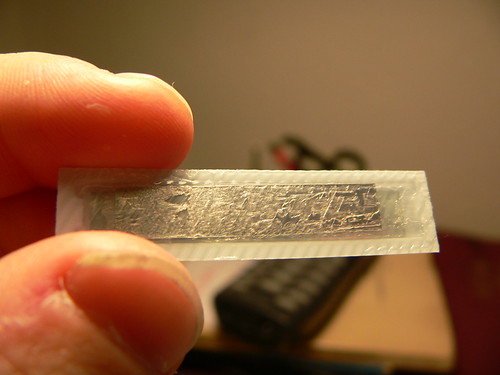
2. This second option is for those are not utilizing their microSD card slots (if available).The plastic around the RFID can usually be trimmed enough so that it is able to fit into a microSD card slot.
I only offer this option as an alternative for those willing and able to do so. Just make sure you can remove the chip from the slot and that there is no way to cause a short while the chip is in the slot.

How to turn your cellphone into a credit/debit card


introHow to turn your cellphone into a credit/debit card


Easy to do mod for an extra credit/debit card with RFID chip (i.e. Paypass).

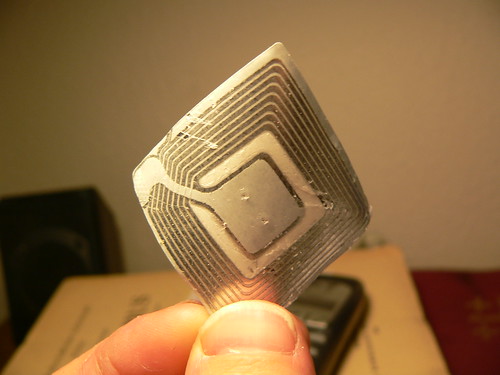
Using this method, you will be able to locate and extract the RFID chip in your spare
Paypass-capable card and place it in your cellphone. This will allow you to present your cellphone at Paypass terminals (movie theaters, McDonalds, etc..) and pay using the RFID chip.

step 4How to kill your RFID chip


step 4How to kill your RFID chip


In this step I will describe a few ways to permanently disable or kill an RFID chip. Most products that you own that contain RFID tags belong to you, so you have the right to destroy them; however, tampering with a US passport is a federal offense. Luckily there are ways to kill an RFID tag without leaving any evidence, so as long as you are careful, it would be pretty hard to prove that you did anything illegal.


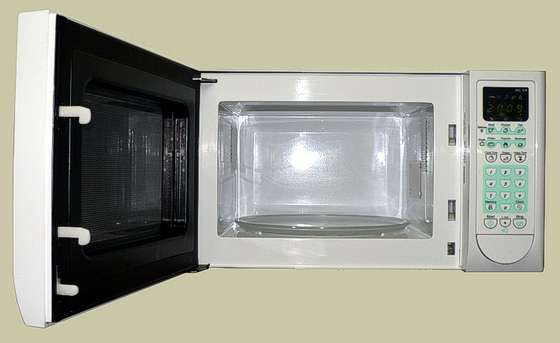
-The easiest way to kill an RFID, and be sure that it is dead, is to throw it in the microwave for 5 seconds. Doing this will literally melt the chip and antenna making it impossible for the chip to ever be read again. Unfortunately this method has a certain fire risk associated with it. Killing an RFID chip this way will also leave visible evidence that it has been tampered with, making it an unsuitable method for killing the RFID tag in passports. Doing this to a credit card will probably also screw with the magnetic strip on the back making it un-swipeable.

-The second, slightly more convert and less damaging, way to kill an RFID tag is by piercing the chip with a knife or other sharp object. This can only be done if you know exactly where the chip is located within the tag. This method also leaves visible evidence of intentional damage done to the chip, so it is unsuitable for passports.

-The third method is cutting the antenna very close to the chip. By doing this the chip will have no way of receiving electricity, or transmitting its signal back to the reader. This technique also leaves minimal signs of damage, so it would probably not be a good idea to use this on a passport.

-The last (and most covert) method for destroying a RFID tag is to hit it with a hammer. Just pick up any ordinary hammer and give the chip a few swift hard whacks. This will destroy the chip, and leave no evidence that the tag has been tampered with. This method is suitable for destroying the tags in passports, because there will be no proof that you intentionally destroyed the chip.

step 3How to block a RFID tag


step 3How to block a RFID tag


Luckily RFID tag signals can easily be blocked. This means that you will have the option to use the tag whenever you want, and prevent others from being able to read it.

The signal sent out by a RFID tag is easily blocked by metal. This means that placing the RFID tag inside of a Faraday cage will prevent the information from being read.

There are already two Instructables on how to build RFID blocking containers:

RFID Secure Wallet

Make a RFID Shielding Pouch Out of Trash

Or if you would rather spend money on something you could build, head over to Think Geek for their RFID blocking wallet and RFID blocking Passport Holder .


step 2Where can RFID chips be found


As RFID chips become cheaper, the number of devices that include them grows.

Currently there are RFID tags in:

- US passports: The RFID tag contains all the information that is written in the passport, along with a digital picture

- Transportation payments: Things like New York's EZ Pass, Florida's Sun Pass, and California's Fast Trak are all RFID based toll payment systems.

- Access control: Many buildings and schools require RFID tagged cards to be used for entry.

- Credit cards: Chase, and a few other banks, now issue credit cards embedded with RFID chips, called "blink". They are able to convince people it is an added convenience, but in reality it is a huge security risk.


There are many other devices which contain RFID tags; however, the ones listed are the most common and offer the greatest security risk.

step 1Reasons for blocking / destroying RFID chips


step 1Reasons for blocking / destroying RFID chips


The main reason someone would want to block or destroy RFID chips would be to maintain privacy. In the last step I explained that RFID tags can be read from very long distances. The potential for abuse of this technology grows as more and more products and devices are being created with these tags built in.

Companies are getting consumers to blindly accept many RFID tagged products with the promise of convenience; however, most of the devices that contain RFID tags don't really need them. The tags may save a few seconds, but sacrifice an enormous amount of privacy and security. It is now possible for someone, with relatively simple equipment, to walk down a busy sidewalk and pickup the personal information of people carrying RFID tagged devices, without them even knowing.

Being able to block or destroy these chips allows people to decide what type of information they are willing to sacrifice for convenience.

introHow to block/kill RFID chips


introHow to block/kill RFID chips


In this Instructable I will describe different ways to block or kill RFID tags. RFID stands for Radio Frequency Identification. If you do not know about this technology yet, you should definitely start familiarizing yourself with it, because the number of different devices that utilize these types of tags is growing exponentially.

RFID chips are very similar to barcodes in the sense that a certain amount of data is contained within them, and then transmitted to a reading device which then processes and utilizes the information. The major difference is that barcodes have to be physically visible to the reading device, which is usually only able to scan them at a distance of a 12 inches or less. RFID tags, on the other hand, do not have to be visible to the reading device. They can be scanned through clothes, wallets, and even cars. The distance from which they can be read is also much greater than that of a barcode. At DEFCON an RFID tag was scanned at a distance of 69 feet, and that was back in 2005, the possible reading distance now is probably much greater than that.

There are a few different categories of RFID tags, but the most common ones, and the ones we will be dealing with in this instructable, are the "passive" type. Passive RFID chips contain no internal power supply. They contain an antenna which is able to have a current induced in it when within range of the RFID reader. The tag then uses that electricity to power the internal chip, which bounces its data back out through the antenna, where it will be picked up by the reader.

For more information on RFID tags check out the wikipedia entry.


Who's using RFID?

Thing by Jakob Smith.RFID is already in use all around us. Ever chipped your pet dog or cat with an ID tag? Or used an EZPass through a toll booth? Or paid for gas using ExxonMobils' SpeedPass? Then you've used RFID.

Some uses, especially those related to security, seem like a great idea. For instance, Delta is testing RFID on some flights, tagging 40,000 customer bags in order to reduce baggage loss and make it easier to route bags if customers change their flight plans.

Three seaport operators - who account for 70% of the world's port operations - agreed to deploy RFID tags to track the 17,000 containers that arrive each day at US ports. Currently, less than 2% are inspected. RFID tags will be used to track the containers and the employees handling them.

The United States Department of Defense is moving into RFID in order to trace military supply shipments. During the first Gulf War, the DOD made mistakes in its supply allocation. To streamline operations, the U.S. military has placed RFID tags on 270,000 cargo containers and tracks those shipments throughout 40 countries.

On a smaller level, but one that will instantly resonate with security pros, Star City Casino in Sydney, Australia placed RFID tags in 80,000 employee uniforms in order to put a stop to theft. The same idea would work well in corporate PCs, networking equipment, and handhelds.

In all of these cases, RFID use seems reasonable. It is non-intrusive, and it seems to balance security and privacy. Other uses for RFID, however, may be troublesome.

Visa is combining smart cards and RFID chips so people can conduct transactions without having to use cash or coins. These smart cards can also be incorporated into cell phones and other devices. Thus, you could pay for parking, buy a newspaper, or grab a soda from a vending machine without opening your wallet. This is wonderfully convenient, but the specter of targeted personal ads popping up as I walk through the mall, a la Minority Report, does not thrill me.

Michelin, which manufactures 800,000 tires a day, is going to insert RFID tags into its tires. The tag will store a unique number for each tire, a number that will be associated with the car's VIN (Vehicle Identification Number). Good for Michelin, and car manufacturers, and fighting crime. Potentially bad for you. Who will assure your privacy? Do you really want your car's tires broadcasting your every move?

The European Central Bank may embed RFID chips in the euro note. Ostensibly to combat counterfeiters and money-launderers, it would also enable banks to count large amounts of cash in seconds. Unfortunately, such a move would also makes it possible for governments to track the passage of cash from individual to individual. Cash is the last truly anonymous way to buy and sell. With RFID tags, that anonymity would be gone. In addition, banks would not be the only ones who could in an instant divine how much cash you were carrying; criminals can also obtain power transceivers.

Several major manufacturers and retailers expect RFID tags to aid in managing the supply chain, from manufacturing to shipping to stocking store shelves, including Gillette (which purchased 500 million RFID tags for its razors), Home Depot, The Gap, Proctor & Gamble, Prada, Target, Tesco (a United Kingdom chain), and Wal-Mart. Especially Wal-Mart.

The retail giant, the largest employer in America, is working with Gillette to create "smart shelves" that can alert managers and stockboys to replenish the supply of razors. More significantly, Wal-Mart intends for its top 100 suppliers to fully support RFID for inventory tracking by 2005. Wal-Mart would love to be able to point an RFID reader at any of the 1 billion sealed boxes of widgets it receives every year and instantly know exactly how many widgets it has. No unpacking, no unnecessary handling, no barcode scanners required.

RFID 101

RFID by Jakob Smith.

Invented in 1969 and patented in 1973, but only now becoming commercially and technologically viable, RFID tags are essentially microchips, the tinier the better. Some are only 1/3 of a millimeter across. These chips act as transponders (transmitters/responders), always listening for a radio signal sent by transceivers, or RFID readers. When a transponder receives a certain radio query, it responds by transmitting its unique ID code, perhaps a 128-bit number, back to the transceiver. Most RFID tags don't have batteries (How could they? They're 1/3 of a millimeter!). Instead, they are powered by the radio signal that wakes them up and requests an answer.

Most of these "broadcasts" are designed to be read between a few inches and several feet away, depending on the size of the antenna and the power driving the RFID tags (some are in fact powered by batteries, but due to the increased size and cost, they are not as common as the passive, non-battery-powered models). However, it is possible to increase that distance if you build a more sensitive RFID receiver.

RFID chips cost up to 50 cents, but prices are dropping. Once they get to 5 cents each, it will be cost-efficient to put RFID tags in almost anything that costs more than a dollar.

RFID Chips Are Here


RFID chips are being embedded in everything from jeans to paper money, and your privacy is at stake.

Bar codes are something most of us never think about. We go to the grocery store to buy dog food, the checkout person runs our selection over the scanner, there's an audible beep or boop, and then we're told how much money we owe. Bar codes in that sense are an invisible technology that we see all the time, but without thinking about what's in front of our eyes.

Bar codes have been with us so long, and they're so ubiquitous, that its hard to remember that they're a relatively new technology that took a while to catch on. The patent for bar codes was issued in 1952. It took twenty years before a standard for bar codes was approved, but they still didn't catch on. Ten years later, only 15,000 suppliers were using bar codes. That changed in 1984. By 1987 - only three years later! - 75,000 suppliers were using bar codes. That's one heck of a growth curve.

So what changed in 1984? Who, or what, caused the change?

Wal-Mart.

When Wal-Mart talks, suppliers listen. So when Wal-Mart said that it wanted to use bar codes as a better way to manage inventory, bar codes became de rigeur. If you didn't use bar codes, you lost Wal-Mart's business. That's a death knell for most of their suppliers.

The same thing is happening today. I'm here to tell you that the bar code's days are numbered. There's a new technology in town, one that at first blush might seem insignificant to security professionals, but it's a technology that is going to be a big part of our future. And how do I know this? Pin it on Wal-Mart again; they're the big push behind this new technology.

So what is it? RFID tags.

Wednesday, November 18, 2009

Integrated RFID Solutions

Because ActiveWave designs its own RFID tags, readers, and host software, we are able to provide you with a seamless integrated RFID solution. An ActiveWave RFID integrated solution is capable of tracking such diverse elements as containers, pallets, furniture, test equipment, vehicles, and hospital patients.
Real-Time Inventory Tracking
An Active RFID integrated solution can generate an updated inventory and track the exact location of goods in real time. The system can keep track of virtually any activity of the tagged equipment or inventory. The system will identify and track the items at any point in the warehouse or any part of the building that the system is installed.
Total Visibility through RFID
An ActiveWave RFID integrated solution can help reduce the obsolete stock by providing real time product status information. The amount of idle inventory tied up in store and warehouses can thus be dramatically reduced through the effective use of information that this system will provide.
Our RFID integrated solution is capable of displaying a map of the warehouse, parking lot, or building depending on the RFID application. This map, stored in our database, can be used by your personnel to search for the location of a person, equipment or inventory, and display their location in real-time.
Reconciliation of Inventory
Currently, the process of reconciling actual inventory against the product database is very time consuming and expensive especially if done manually or through the use of barcodes.
An ActiveWave RFID integrated solution, on the other hand, can check stock and inventories received and dispatch items automatically.
Reduction of Theft and Shrinkage
The system will allow internal theft and other forms of inventory shrinkage to be rapidly identified, and eliminated.